
Best Opening Move in Backgammon: Top Strategies Revealed
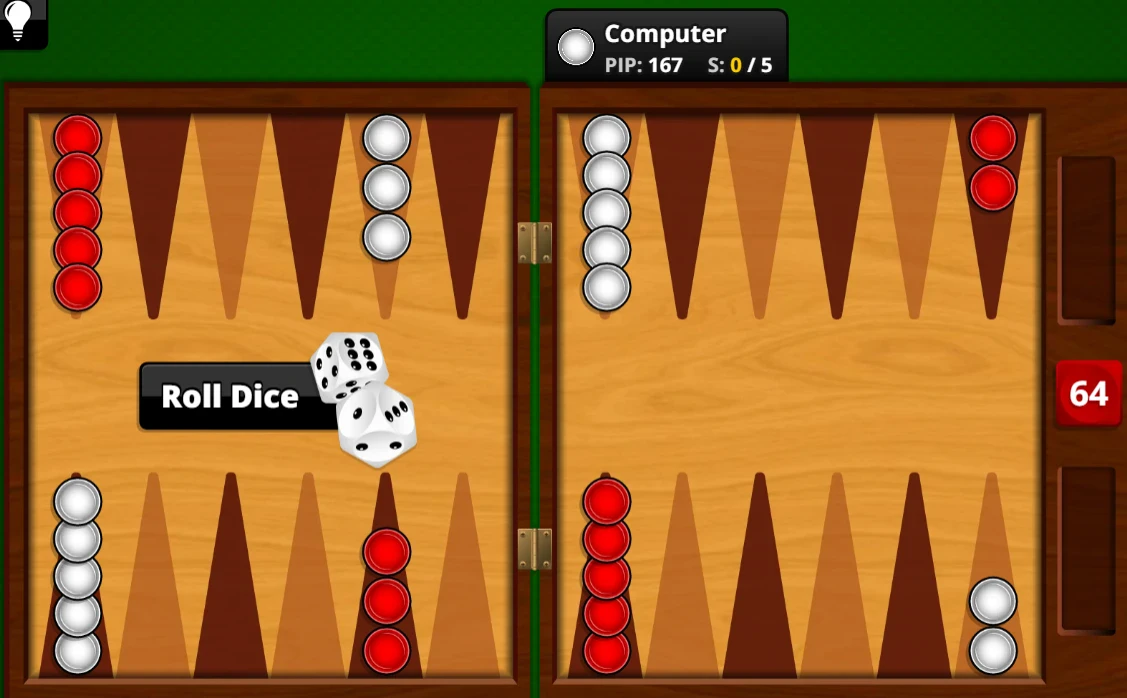
Backgammon is one of the oldest and most commonly played two-player strategy board games in existence, potentially dating back 5,000 years while still being played by millions of people today. While every move is vital as you look to move your checkers into the tray, there is no question that a strong opening move can instantly put the game in your control.
As with every move, there is a degree of luck involved as dice rolls determine who goes first and how many point moves you can make. Nevertheless, strategic plays should be made regardless of what number you roll. This quick guide will help you get your game off to a perfect start.
1. Understanding Backgammon Opening Moves
The first thing to note about backgammon is that, unlike chess, there is no predetermined rule about who goes first. You will roll a single die to learn who goes first, with the highest score winning and a draw resulting in a re-roll, meaning it doesn't matter which color you play as. Similarly, the presence or absence of the doubling cube should not impact your strategy for the individual game.
Before rolling, the backgammon board layout will see your 15 checkers spread out across 24 points on the board. This is split into four sections known as your home board, your outer board, the opponent's outer board, and the opponent's home board. The goal is to move your checkers clockwise into your home board section before subsequently moving them into the tray. When starting, the checkers are placed in the following spaces;
- 24-Point (2 checkers).
- 13-Point (5 checkers).
- 8-Point (3 checkers).
- 6-Point (5 checkers).
The value of your opening move will be determined by the roll of the two dice. In subsequent moves, you will roll both dice. However, the opening move is dictated by the initial roll both players used to discover who goes first. Due to the re-roll rule if both players hit the same number, it is impossible to score a double on the first roll
There are 30 possible outcomes, including 15 possible winning outcomes, as shown:
| 1 | 2 | 3 | 4 | 5 | 6 | |
|---|---|---|---|---|---|---|
| 1 | N/A | 3 point moves | 4 point moves | 5 point moves | 6 point moves | 7 point moves |
| 2 | Opponent wins | N/A | 5 point moves | 6 point moves | 7 point moves | 8 point moves |
| 3 | Opponent wins | Opponent wins | N/A | 7 point moves | 8 point moves | 9 point moves |
| 4 | Opponent wins | Opponent wins | Opponent wins | N/A | 9 point moves | 10 point moves |
| 5 | Opponent wins | Opponent wins | Opponent wins | Opponent wins | N/A | 11 point moves |
| 6 | Opponent wins | Opponent wins | Opponent wins | Opponent wins | Opponent wins | N/A |
This means that the total point moves for the opening move will be between 3 and 11, with 7 (a 3/15 or 20% chance) the most likely outcome. Whichever quadrant the checker is moved from, it can only move in an anti-clockwise direction towards your home board and tray.
However, the move is split as per the two individual scores. If you roll a 4 + 3, you could move one checker 7 spaces or move one checker 4 spaces and another 3 spaces. Therefore, a 4 + 3 opening move may be played differently to a 5 + 2 or 6 +1.
2. Key Moves to Win at Backgammon
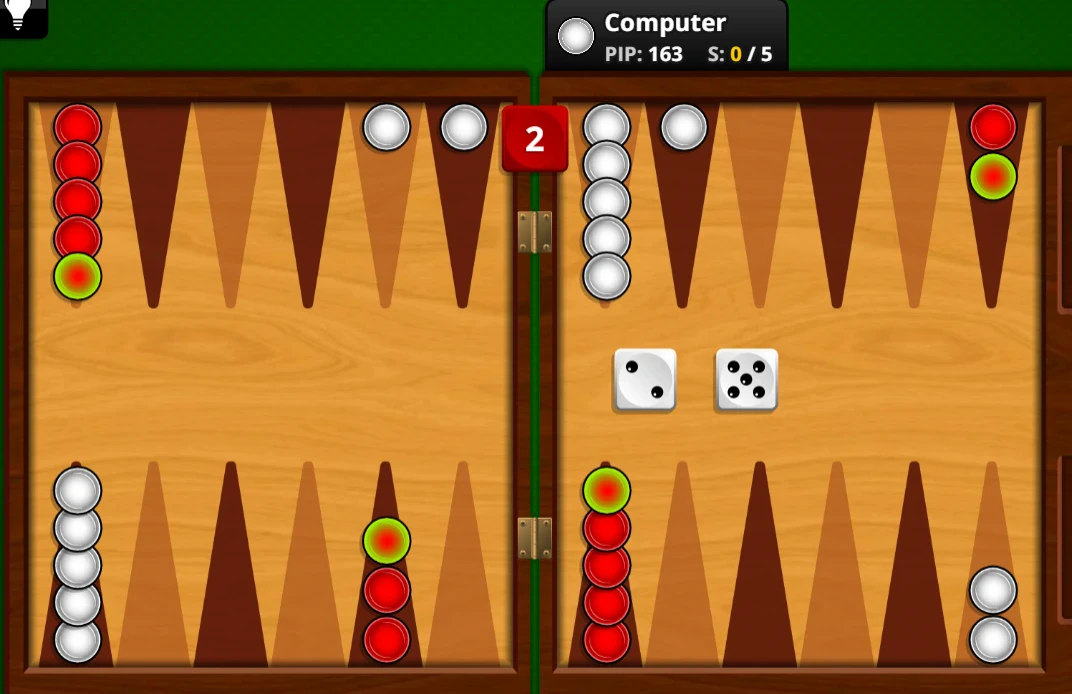
Backgammon is a strategic battle where every move matters and in which your tactics can be heavily influenced by your opponent's moves, as well as the dice rolls. Therefore, it's important to remember that a great opening must be contextualized by the game as a whole.
Even when playing your opening move, you should always think about the following features of a backgammon strategy;
- The importance of blots. A blot is created when a single checker occupies a point on the board. Should the opponent land on it, they can send this checker to the bar, which means it then has to circle the entire board again.
- Building points. As well as taking your opponent's blots, you want to remove any potential risk to your checkers by ensuring that you have at least two in any point on the board. Building points strengthens your position greatly.
- Creating primes. Once you have built a point, the opponent cannot move into this space. A prime is built when you have control of consecutive points. If you occupy six in a row, any of the opponent's checkers that sit behind this will be trapped.
- Stacking. Stacking is when you have three or more checkers in a point. Three is an OK number as it means you can move one without creating a blot, but more than that can be overkill that reduces your flexibility.
Some of the above plays are impossible on the opening move. For example, your opponent won't have any blots to hit on your first move (unless they move first and leave themself exposed). Still, thinking about the possibilities of how your game may develop over the coming moves is one of the key features of an advanced strategy.
3. Exploring Backgammon Opening Strategies
Understanding the basics of how to assert dominance in backgammon is a great starting point for plotting your opening move and subsequent attacks. Still, it's important that you actually play a logical first move.
There are 15 possible rolls you could land for that first move, ranging from 2 + 1 to 6 + 5. The best roll you could get is a 3 + 1. In this case, you can move one checker from point 8 and one checker from point 6. This creates a point in position 5. Crucially, this also results in a small prime (points 5 and 6), which makes it harder for your opponent to get back out if you were to take a blot later on. It additionally means you have an extra checker in your home board without exposing yourself to any blots. Perfect.
Opening strategies can focus on forming points, particularly in areas that could block or limit your opponent's potential moves. A 5:1 is another very strong first roll as you can move one checker five spaces from point 13 and one checker from point 9 to create a new stack in point 8. In this case, you've also created a prime that covers positions 6, 7, and 8.
There is no exact one move you should always play, but the following table provides some of the best options for each roll.
| Roll | Move | Reason | Alternative |
|---|---|---|---|
| 2 + 1 | Checker 1: 13 to 11 Checker 2: 24 to 23 |
Split back checkers. Flexibility near your home board | Checker 1: 13 to 11 Checker 2: 6 to 5 |
| 3 + 1 | Checker 1: 8 to 5 Checker 2: 6 to 5 |
Control point 5 and create a prime | No alternative should be played |
| 3 + 2 | Checker 1: 24 to 21 Checker 2: 13 to 11 |
Split back checkers. Flexibility near your home board | No alternative should be played |
| 4 + 1 | Checker 1: 13 to 9 Checker 2: 24 to 23 |
Split back checkers. Open attack near the home board | Checker 1: 13 to 9 Checker 2: 6 to 5 |
| 4 + 2 | Checker 1: 8 to 4 Checker 2: 6 to 4 |
Control position 4. Make it hard for the opponent to get out | No alternative should be played |
| 4 + 3 | Checker 1: 13 to 9 Checker 2: 24 to 21 |
Creates opportunities to build points and primes on next move | Checker 1: 13 to 6 |
| 5 + 1 | Checker 1: 13 to 8 Checker 2: 24 to 23 |
Split back checkers. Future point building in your home board | Checker 1: 13 to 8 Checker 2: 6 to 5 |
| 5 + 2 | Checker 1: 13 to 8 Checker 2: 24 to 22 |
Future point building in your home board and advanced anchor | No alternative should be played |
| 5 + 3 | Checker 1: 8 to 3 Checker 2: 6 to 3 |
Build a point in position 3. Block opponent's escape | No alternative should be played |
| 5 + 4 | Checker 1: 13 to 8 Checker 2: 24 to 20 |
Split back checkers. Strong play in opponent's outfield | Checker 1: Checker 2: |
| 6 + 1 | Checker 1: 13 to 7 Checker 2: 8 to 7 |
Build a point in position 7. A prime with point 6 | No alternative should be played |
| 6 + 2 | Checker 1: 24 to 18 Checker 2: 13 to 11 |
Advance one checker on both sides of the board | Checker 1: 24 to 16 |
| 6 + 3 | Checker 1: 24 to 18 Checker 2: 13 to 10 |
Advance one checker on both sides of the board | No alternative should be played |
| 6 + 4 | Checker 1: 24 to 14 | Progress a back checker to your outfield. Flexibility | No alternative should be played |
| 6 + 5 | Checker 1: 24 to 13 | Progress a back checker to the end of your outfield | No alternative should be played |
You can play alternative moves depending on your overall tactic but the above options will serve you well. It should also be noted that certain moves have specific names. The 24 to 13 move on a 6 + 5 is known as Lovers Leap. It doesn't particularly matter, but this knowledge can intimidate human opponents and make them more defensive.
The opening moves above are useful for both standard play and tournament play, as well as on themed boards like Halloween Backgammon. While it is only one move, most people agree that a 3 + 1 is the most powerful start - followed by 6 + 4 or 6 + 1. Play the suggested moves for these rolls and you will gain a strong hold of the early board.
However, if your opponent won the dice roll and you play second, your opening move may be dictated by theirs. If they have created a blot in position 21 and you then roll a 3, you'll want to take the blot by moving one of your checkers from position 24 - even though it does now leave you with blots in both 24 and 21.
4. Essential Tips for Opening Moves
The above exploration of opening moves and their context within the overall strategy should point you in the right direction. For the best results, though, you also need to adopt a winning mindset that increases your hopes of winning.
Backgammon games are won by bearing off, which means getting your checkers around the board and into the tray. Here are some simple tips to help optimize your hopes of success;
- Be aggressive rather than defensive. It is worth leaving a blot if it allows you to create a prime or increase your chances of doing so in the next couple of moves. After all, the chances of the opponents rolling the number needed to land on the blot are often 1 in 6.
- When you have a choice of two strong moves, it's probably best to focus on your home board and the opponent's home board rather than the outer board. This is because they are where the most important action happens.
- If you have the chance to send an opponent's blot to the bar, take it, even if it creates a blot from your end or disrupts a play. Of course, you can't do this if you play first but the opportunity may surface if you go second.
- When it is not possible to play a key point, it's generally better to split your back checkers by bringing one down from the checkpoint. Losing a blot further back will increase your total pip count by a smaller amount.
- Similarly, if you can mount an attack on an opponent, it makes sense to target your back checkers. Taking blots or creating points nearer to their home board and tray will increase their total pip count by the maximum level.
Ultimately, you can't win or lose a game of backgammon with your opening move, but it can set the tone for how both players approach the battle. Use your opening to start an attacking strategy and your pip count will fall in no time.
Seasonal Backgammon Games


More Games




Backgammon News
Disclaimer
DISCLAIMER: The games on this website are using PLAY (fake) money. No payouts will be awarded, there are no "winnings", as all games represented by 247 Games LLC are free to play. Play strictly for fun.